Never lose a BHG recipe again. Find a recipe you love on BHG.com? Click the heart icon to save it (and find it later) with MyRecipes.com.
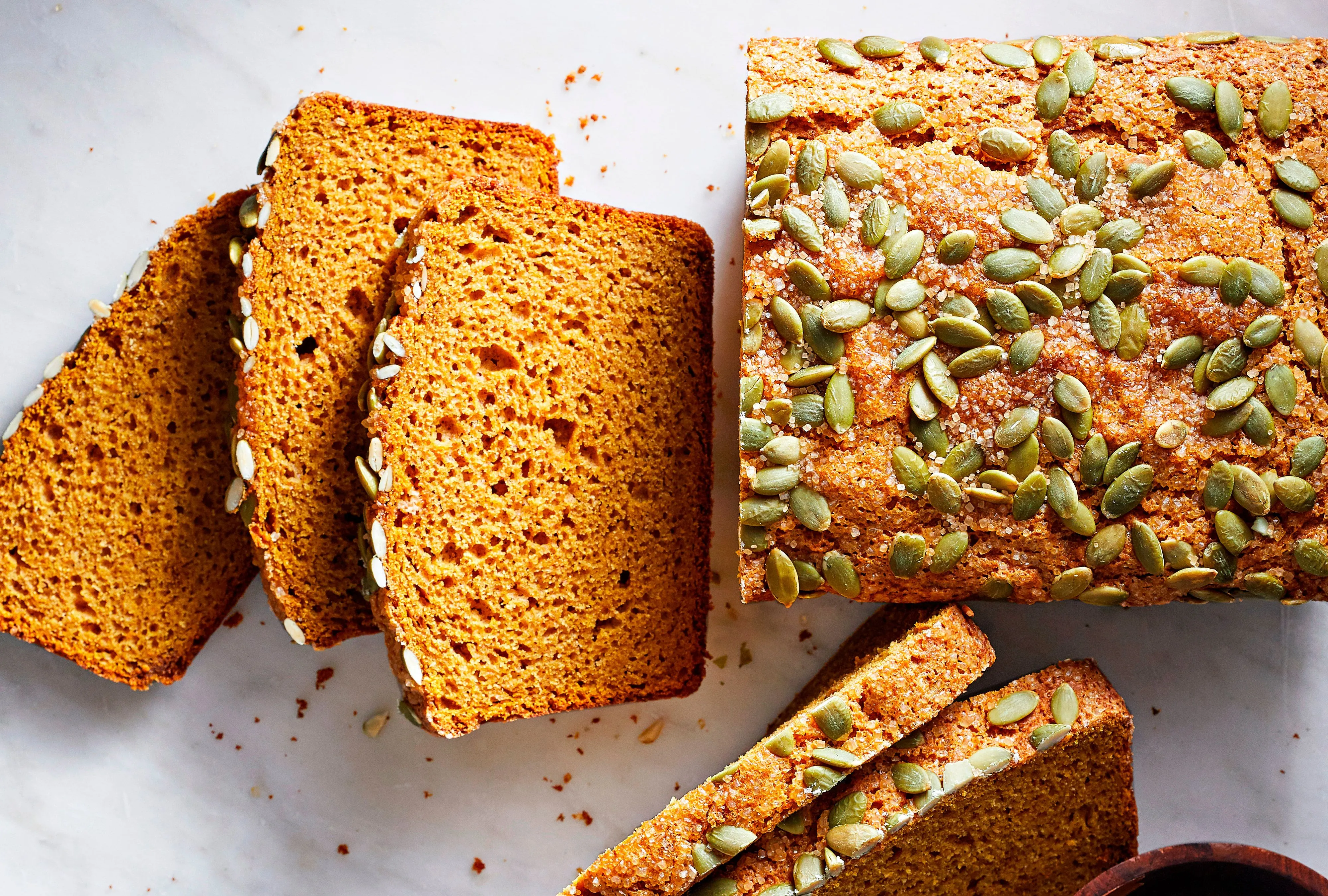
While we love a traditional Pumpkin Bread recipe, this version has amazing flavor depth thanks to the addition of Sourdough Starter discard. It specifically calls for sourdough starter discard rather than active starter, because we are using the starter primarily for flavor instead of leavening (for leavening, the recipe uses baking soda and powder). Active starter better mimics the slow rise leavening action of yeast (in breads and rolls) versus quick acting leaveners like baking soda and powder.
Ingredients
1 1/2cupswhite whole wheat flour
1 1/2tsp.baking powder
1 1/4tsp.fine sea salt
1tsp.baking soda
1tsp.ground cinnamon
1tsp.ground ginger
1/4tsp.ground cardamom
3/4cupcanned pumpkin
3/4cupSourdough Starter discard (info, below)
3/4cuppure maple syrup
1/3cupcanola oil or olive oil
2eggs
2tsp.orange zest
1tsp.vanilla
1/4 cuppepitas (pumpkin seeds)
1Tbsp.turbinado sugar or coarse sugar
Directions
Preheat oven to 350°F. Grease bottom and 1/2 inch up sides of a 9×5-inch loaf pan. Line pan with a 9-inch-wide strip of parchment paper, extending the parchment over the two long sides of pan (to lift the bread from the pan after baking).
In a large bowl combine first seven ingredients (through cardamom). Make a well in center of flour mixture. In a medium bowl whisk together next seven ingredients (through vanilla). Add the pumpkin mixture to the flour mixture.Stir just until moistened. Spoon into prepared pan. Top with pepitas and sugar.
Bake 50 to 55 minutes until a toothpick comes out clean. Cool in pan 15 minutes. Remove and cool completely on a wire rack.
Store at room temperature up to 2 days or store wrapped bread in the refrigerator up to 5 days.
How to Make Sourdough Starter and Discard
Before you end up with sourdough starter discard, you'll need to make your own sourdough starter. Here are the steps to make one, care for it, and how to deal with the discard you'll have left after carrying over a portion for feeding.
Using a rubber spatula, in a quart jar thoroughly mix 110 grams whole wheat or rye flour (a scant 1 cup) and 110 grams filtered water (1/2 cup or 4 oz.). Cover with a damp kitchen towel or loose-fitting lid and let stand at room temperature 24 hours. On Day 2, stir mixture and measure out 110 g (1/2 cup) of starter into a fresh container, discarding the rest (at this point, the discard is not ready to be used in recipes). Feed with 110 grams each flour and the water. Repeat this same process for Days 3 and 4. Cover with a loose-fitting lid to prevent starter from drying out.
By Day 5 your starter should be bubbly, double in size in a day, and smell nutty and sour. (If it doesn't yet look or smell like this, continue with feedings until it does.) At this point, switch to a blend of 50% bread flour and 50% whole wheat flour. (In a large container combine half of a 5-pound bag each of bread and whole wheat flours to use for feedings.) For the next two days (Days 6 and 7), increase feedings to twice a day: once in the morning and once at night.
On Day 8, if your starter is rising and falling at regular intervals and smells fermented, then it's ready to use. Use the starter at peak activity (that's when it doubles more quickly, about 4 hours after feeding). At this point, any discard (that remains after measuring out the 110 grams for feeding), can be used in sourdough discard recipes.
Feeding Schedule
If baking often with active sourdough starter, store the starter at room temperature and feed it every 24 hours using 110 grams sourdough starter, 110 grams flour mixture, and 110 grams filtered water. If baking less often, cover the jar of starter loosely and refrigerate 1 hour after feeding. Feed refrigerated starter once a week to maintain. When ready to use refrigerated starter, let stand at room temperature and continue with feedings twice a day. (We recommend 2 to 3 feedings before using the starter to make bread.) To feed starter to make recipes using active Sourdough Starter (such as Artisan Sourdough), carry forward 110 g starter and feed with 110 g water and 110 g flour mixture.
Storing Discard (Optional)
After you measure out the 110 grams active sourdough starter to use in your next feeding, the remaining starter in the jar is what we call "sourdough starter discard." While you can throw that discard away (composting it is a great option), you can also put that discard to use in recipes like the Sourdough-Discard Pumpkin Bread (above) or Sourdough Discard Oatmeal Cookies. If you're not going to use it right away, store the starter discard in a separate jar in the refrigerator. Let it come to room temperature before using in recipes that call for discard—no feeding necessary. For best results, use within a week. If liquid collects on the top of the discard, stir it in before using.
- <span>Recipes & Cooking</span>
- <span>Desserts & Baking</span>
- <span>Bread</span>
- <span>Dessert Bread & Pastry</span>
New